 Solo
Solo Assist
 Live
Live0.0–3.8
more patients per day, per provider
More patient access without longer days.
Your providers see more patients, your charts close the same day, and the work stops following anyone home.
Trusted by Healthcare Organizations Nationwide



The note writes itself. Chart prep, coding, orders, inbox, and follow-ups all still land on your providers.
They chart at 10pm, your best people burn out, and earned revenue quietly leaks.
A clinical intelligence platform built to carry the entire patient journey, from chart prep through follow-through.
Rotenstein et al., JAMA, 2026;335(16):1408-1417 · five health systems, 8,581 clinicians · Read the study
Documentation time saved
relative reduction from drafting alone
Clinicians who kept using it
used their AI scribe in at least half of visits
After-hours EHR time didn't move
no significant change from drafting alone
Drafting works. The evenings didn't come back.
Documentation time went down, and the after-hours charting the tools were bought to fix held steady. That gap is the work the platform finishes.
Three solutions, all capable in any setting. Each one sets how much of the documentation your providers finish themselves and how much the Scribe-X team finishes for them. Run different solutions for different providers, and every one of them gets their charts closed the same day.
Documentation stops waiting on a provider's evening. Automation drafts the note at encounter close, and providers review and finalize on their own schedule. For teams staffed to keep the finish in house.
Learn moreMostly automation
The finishing comes off your providers. Adaptive automation drafts every note, and a trained Remote Healthcare Assistant completes it into your EHR: entry, orders, and codes carried for you. Revenue depth layers on when you're ready.
Learn moreFinished by a trained RHA
The chart closes at the visit, so nothing carries into the evening. A trained Remote Medical Scribe documents the encounter in real time. The high-touch option for specialized settings and for visits where documentation can't wait.
Learn moreA trained scribe in the visit
Set the mix, provider by provider, and see the impact.
One agreement, tailored to each provider.
Start anywhere, and grow into more as your team is ready. Let's talk →
The platform works before, during, and after every encounter, so the visit doesn't end unfinished.
Providers walk in knowing the patient, with chart prep, problem review, and open care gaps already done.

The visit belongs to the patient while the note, the orders, and the after-visit summary get captured around it.

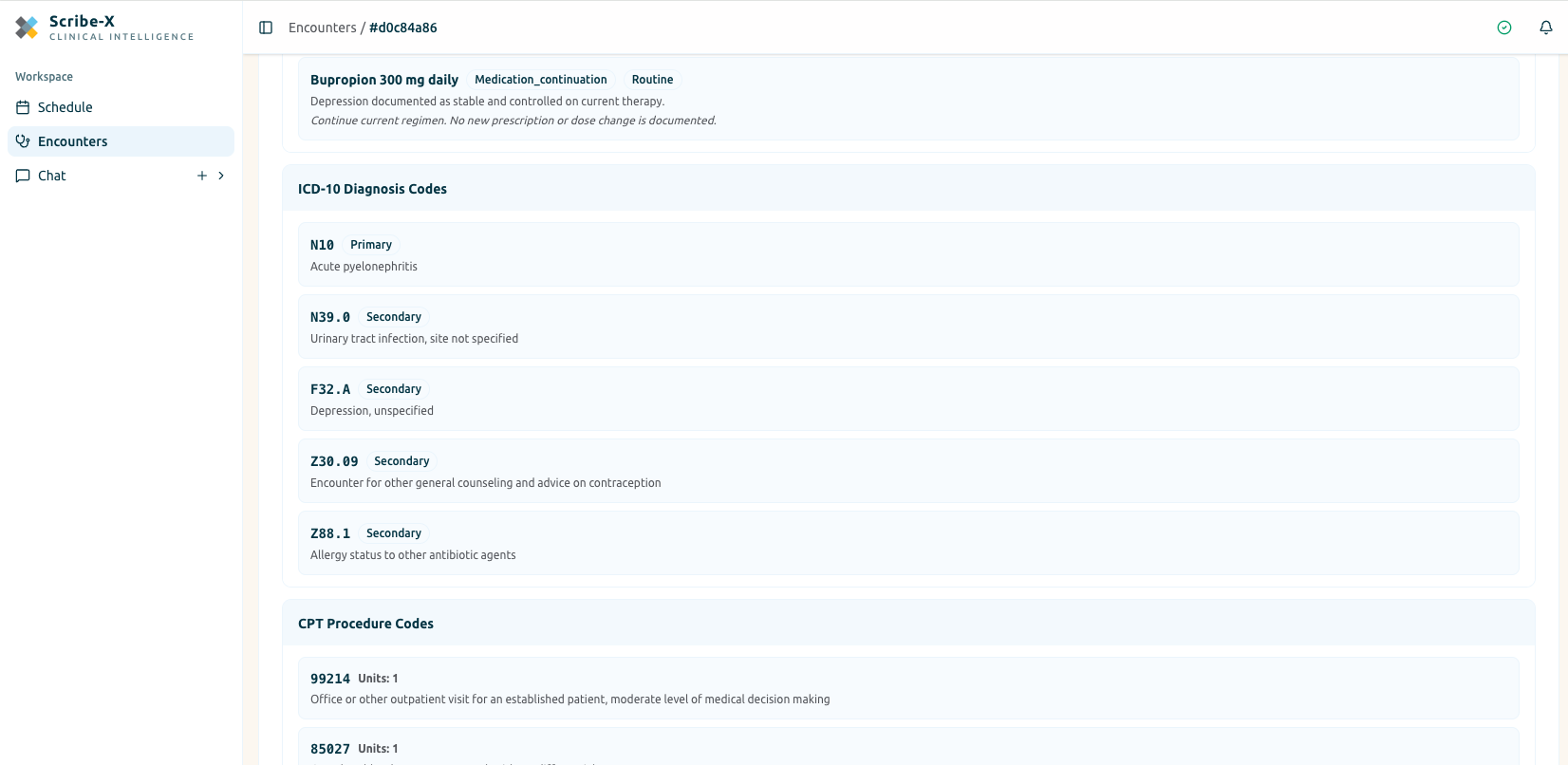
The record supports the level of service provided, with coding completeness, HCC capture, and care gaps surfaced and monitored.
Providers feel it first and the organization counts it: more patient access, revenue landing sooner, and providers who stay. Set Solo, Assist, and Live across your team to get there, with one partner customized to your practice.
more patients per day, per provider
More patient access without longer days.
reduction in days to close
Revenue lands sooner.
provider satisfaction
A clear jump in how providers rate their day.
Less burnout, stronger retention.
higher level-of-service coding captured
better HCC risk capture
Source: Scribe-X client data ranges, 2025 cohort.
Built for PHI from day one, quick to adopt, and ready with a documented answer before a reviewer asks for one.
Encryption in transit (DTLS/SRTP, TLS over 443) and at rest.
Built around HIPAA-compliant workflows, end to end.
Access is scoped by role across the platform.
User and administrator activity logging for audit.
Day 1 human-mediated integration and no customer-side servers.
Hosted on AWS, so there's nothing to run or maintain on your side.
Providers get to be present with their patients again. Here it is, in their words.
Life-changing. From a work-life balance perspective, this has worked great. I walk out of here and my charts are done.
Four quick questions. See where your practice is losing time and revenue, and which solution fits, before you ever talk to us.
Question 1 of 4
The questions clinical and IT leaders ask us most, answered straight.
Native AI generates a note. Scribe-X supports the full visit: chart prep before, a trained person finishing the work after, and the follow-through that closes the loop, tailored to how each provider works. That's where documentation problems actually live.
Built-in tools handle the encounter for providers who use them. They don't prep the chart, adapt to individual workflows, or support providers who won't drive the technology themselves. Scribe-X covers what happens around the note.
Adaptive automation drafts the documentation across the encounter. Scribe-X pairs it with trained people who carry the gaps automation can't reach yet, so every provider gets support tailored to how they work. What lands in your chart is complete enough to sign and specific enough to hold up.
Most organizations are live within a few weeks of contract signing. Your onboarding contact walks through the process before anything is signed, with timeline and go-live specifics outlined upfront so there are no surprises on go-live day.
Scribe-X works with all major EHR platforms. No integration is required for most solutions. Scribe-X learns your specific platform and your workflows, and compatibility and any edge cases get confirmed during discovery before anything is signed.
Most implementations require standard EHR access provisioning and a BAA review. Scribe-X handles the setup process end to end, so IT gets looped in where it's needed and never asked to carry the project.
Scribe-X scales from a single clinic to a multi-site health system. The right support model depends on your provider mix, your workflows, and how much of the work around the visit you want Scribe-X to carry. Your contact scopes the fit during discovery.
Across the 2025 client cohort, providers saw 1.9 to 3.8 more patients per provider per day, 28 to 62% faster days to close, and a 20 to 40% improvement in provider satisfaction. Scribe-X can build a tailored ROI analysis that ties the program to retention, revenue cycle, and capacity in numbers a board can act on.
Yes. Scribe-X executes a BAA before any provider encounter. The platform is built with HIPAA-compliant controls: encrypted in transit and at rest, with role-based access and audit logging. Detailed security documentation is available on request.
Your account team stays active after go-live, monitoring performance, supporting slower-to-adapt providers, and flagging issues early. We start from your definition of success and work backwards. If something isn't working, you have a named contact and a defined path to reach them.
Still have questions? Book a Meeting →